









The way the world measures national success is changing. Governments, international institutions and research bodies are moving away from GDP as the primary indicator of a country’s prosperity. In its place, a broader standard is taking hold.
It asks not merely how much a nation produces, but how well it provides for the health, education, environmental security and social well-being of its people.
The 2026 Good Life Index, published by CS Global Partners, puts this shift into focus. The Index shows that nations investing most comprehensively in their people consistently deliver the highest quality of life.
Why GDP Alone Is No Longer Enough
For most of the 20th century, GDP held an almost unchallenged position as the defining measure of national progress. Its logic was straightforward. If a country produced more goods and services than it did the previous year, it was doing better.
The Index shows that a well-functioning society depends on a range of human development factors that extend well beyond economic growth. A measurement framework that ignores them does not merely fail to capture reality. It actively distorts the decisions governments make and the policies they pursue.
“Infrastructure, education, healthcare, and environmental sustainability all contribute to a higher quality of life, fostering happier, more secure societies,” the report states.
The Three Pillars of Holistic Well-Being
The Good Life Index organises its assessment around three broad pillars. Each one represents a dimension of human flourishing that GDP systematically ignores.
The first is health. It is measured not only through life expectancy at birth but through the underlying conditions that determine it. These include poverty rates, political stability and access to medical care. A nation may generate enormous wealth while leaving significant portions of its population without adequate healthcare. The index captures that failure in ways that GDP cannot.
The second is the environment. The index evaluates nations on climate resilience, environmental protection, food security, crop vitality, and air and water quality. This dimension reflects a clear recognition. Long-term human well-being is inseparable from the health of the natural systems on which all life depends. A country that grows its economy by degrading its environment is making a transaction that future generations will be forced to reverse.
The third pillar is the economy. But it is defined far more broadly than GDP. The index examines growth potential, gross national income, literacy rates, and educational and skills attainment. Economic capacity features in the framework. It is, however, one component among several and not the measure of everything.
The practical consequences of this broader framework become clear when applied across nations. Countries with universal healthcare, high-quality public education, strong environmental regulation and generous social safety nets consistently outperform those that rely on economic output alone. The pattern, the report argues, is not coincidental. It is structural.
Norway As An Example To The World
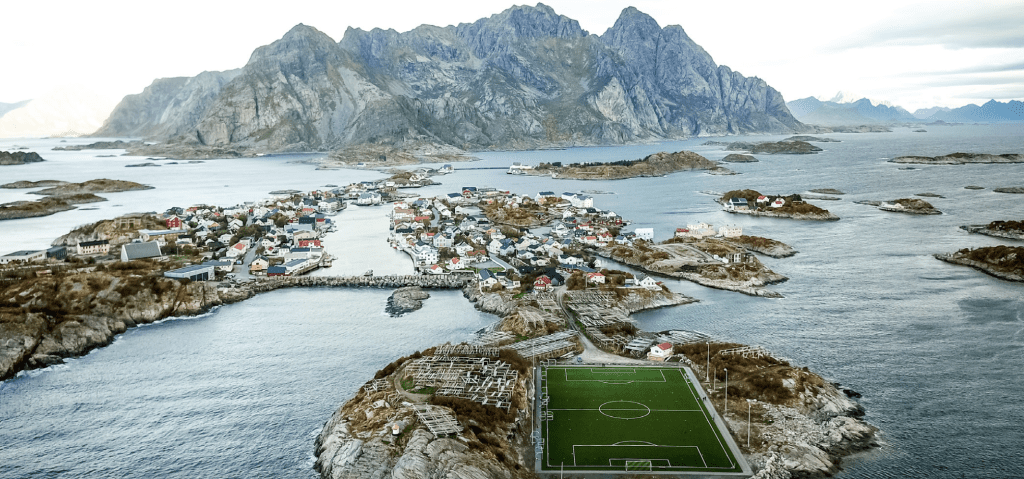
Norway stands as the report’s flagship example. Life expectancy at birth stands at 83.6 years, underpinned by universal healthcare and a preventive medical culture. Education access is near-universal with strong outcomes across literacy and skills development. Environmental performance is equally distinguished.
Norway excels in renewable energy, biodiversity protection and ecosystem management. Workers enjoy a standard week of approximately 37.5 hours and more than five weeks of paid annual leave. Institutional trust is among the highest recorded anywhere in the world.
Its standing does not derive from oil wealth alone. It comes from the deliberate investment of that wealth into the full range of conditions that allow people to live well.
“Norway proves that the good life isn’t just about wealth,” the index states. “It’s about creating societies where people thrive sustainably, equitably, and joyfully.”
The United States presents a sharply contrasting picture. Despite commanding the world’s largest economy in absolute terms, it falls well below many nations with smaller economies when measured against holistic well-being criteria. Its lack of universal healthcare, wide income inequalities and relatively poor environmental performance drag its composite score well below those of nations with more comprehensive social and environmental investments.
The gap between America’s economic dominance and its quality-of-life standing is, the report argues, precisely the point. GDP growth and genuine national well-being are not the same thing. Conflating the two comes at a measurable human cost.
“The data show that a truly good life extends beyond economic power. It demands societies that nurture health, education, environment, and human connections for lasting prosperity.” Good Life Index 2026.
The Human Cost of Measuring Progress Too Narrowly
The index’s findings carry direct implications for how governments prioritise public spending. Nations that have historically placed economic growth above social and environmental investment are now confronting measurable costs in human well-being. These are costs that narrow fiscal metrics were never designed to detect.
The environmental dimension adds a further layer. Poor air and water quality, lagging climate policy and degraded ecosystems are not abstractions. They translate directly into health outcomes, food security and long-term economic resilience. All of these feed back into quality-of-life scores. A government that does not measure these things is, in effect, choosing not to govern them.
The shift towards holistic well-being measurement is not merely academic. It carries direct, practical consequences for how governments allocate resources, how international institutions evaluate national progress, and how individuals make decisions about where to build their lives.